Pothole Detection Challenge: Dataset & Annotation Guide
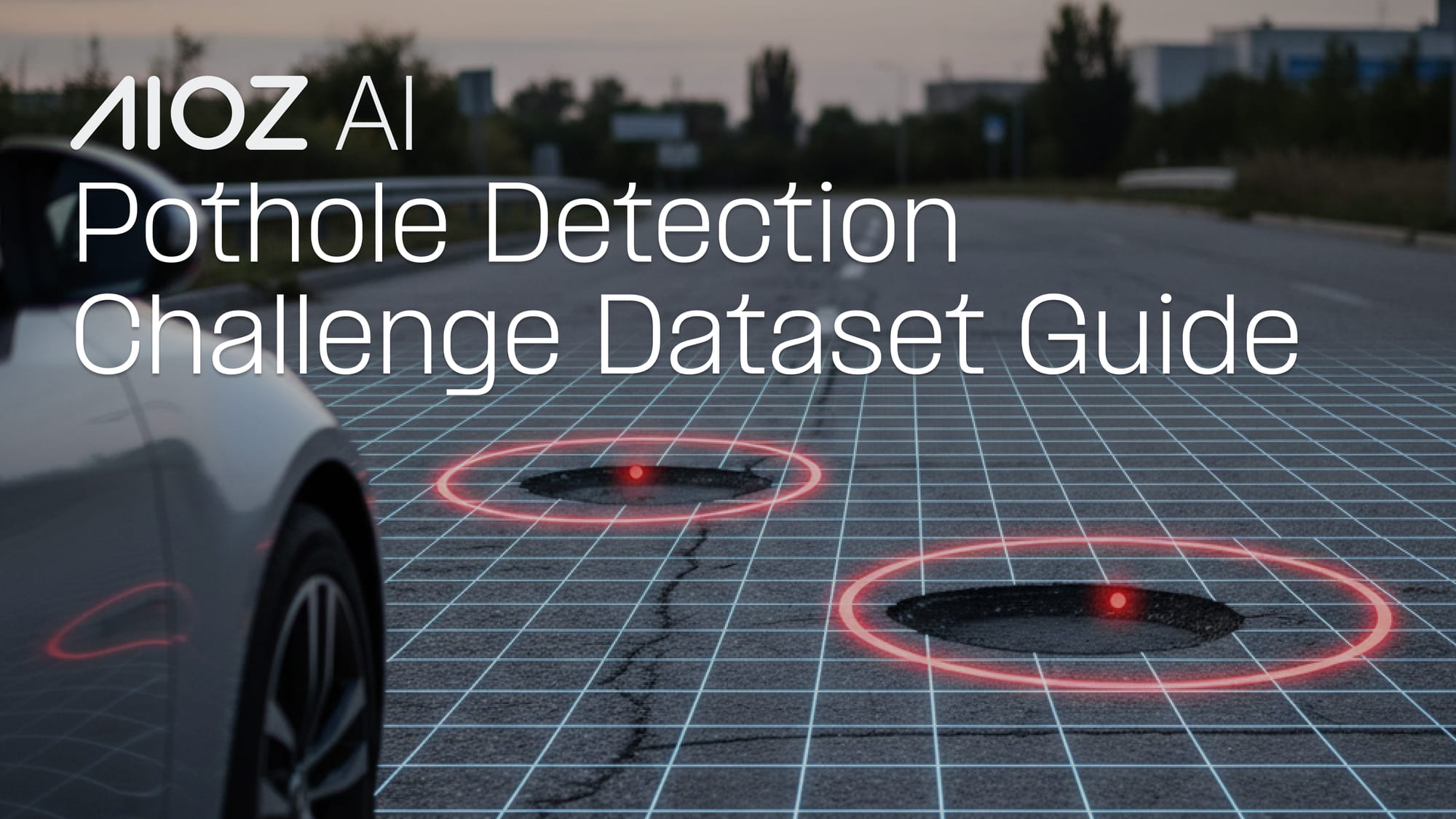
Welcome to the newly launched Pothole Detection Challenge!
Your mission is simple but powerful: train a model that can spot potholes in real road images and draw a clean, accurate box around each one.
The images are deliberately captured in messy situations — city streets, rural roads, highways, daytime, nighttime, rainfall, glare, dash-cams, drones, CCTV, etc. It reflects the exact chaos that cities and navigation tools deal with every day.
This guide walks you through everything you need to know about the data, labels, and challenge submission format, so your model goes straight to the leaderboard without friction.
What’s Inside the Dataset
Expect a wide variety of road settings in the real world:
- Busy city streets, highways, and backroads.
- Bright daylight, dark nights, rainfall, glare, harsh shadows, etc.
- Pictures taken from car dashboards, CCTV poles, and flying drones.
That variety is intentional. A strong model performs everywhere, not just on perfect sunny photos.

How Labels Work (Super Simple)
Every training photo comes with a small text file listing all the potholes in the image.
Each pothole is described with just five numbers:
- The class → always 1 (because 1 = pothole)
2–5. Where the pothole is and how big it is (center position + width + height)
All four position numbers are already normalized between 0 and 1 (proportions of the image size, not raw pixels). This makes life easier for your model.
E.g.: 1 0.45 0.62 0.18 0.12
(class 1 = pothole | the four numbers = center-x, center-y, width, height, all normalized 0–1)
What You Have to Submit
You can participate in two ways:
1. Quick public leaderboard check
Submit a CSV with two columns:
- Column 1: the image name (id)
- Column 2: all your detections for that image written in one long string, separated by spaces
Example line (two potholes found in the same photo):
img_001, 1 0.98 0.45 0.32 0.18 0.12 1 0.87 0.71 0.55 0.20 0.09 That’s it — one row per photo.
2. Final private ranking (the one that really counts)
Upload your full code and model. The system runs it on a hidden test set. This prevents tuning on the public leaderboard.
Full submission details are in the Submission Guide here.

How the Winner Is Chosen
The scoring mechanism used is called [email protected] (Mean Average Precision at 50% overlap).
In plain words: If a box drawn by your model overlaps the real pothole by at least half its area, you earn credits. The more accurate your confident detections are, the better your rank.
The private test set determines the final results.
Five Things People Tend To Miss
- Coordinates are normalized (0–1), not pixels.
- Class is always 1 for potholes.
- One row per image in the CSV.
- You must include a confidence score for every box.
- Public leaderboard is just a format check — don’t over-optimize it.
Ready to Start?
Everything you need is waiting on the challenge page.
Download the data, start experimenting, and help make roads safer.
One accurate bounding box at a time.
Registration is open.
Jump in NOW → https://aiozai.network/challenges/pothole-detection-challenge-5598
See you on the leaderboard!