License Plate Recognition: A Detect & Read Computer Vision Challenge
TL;DR
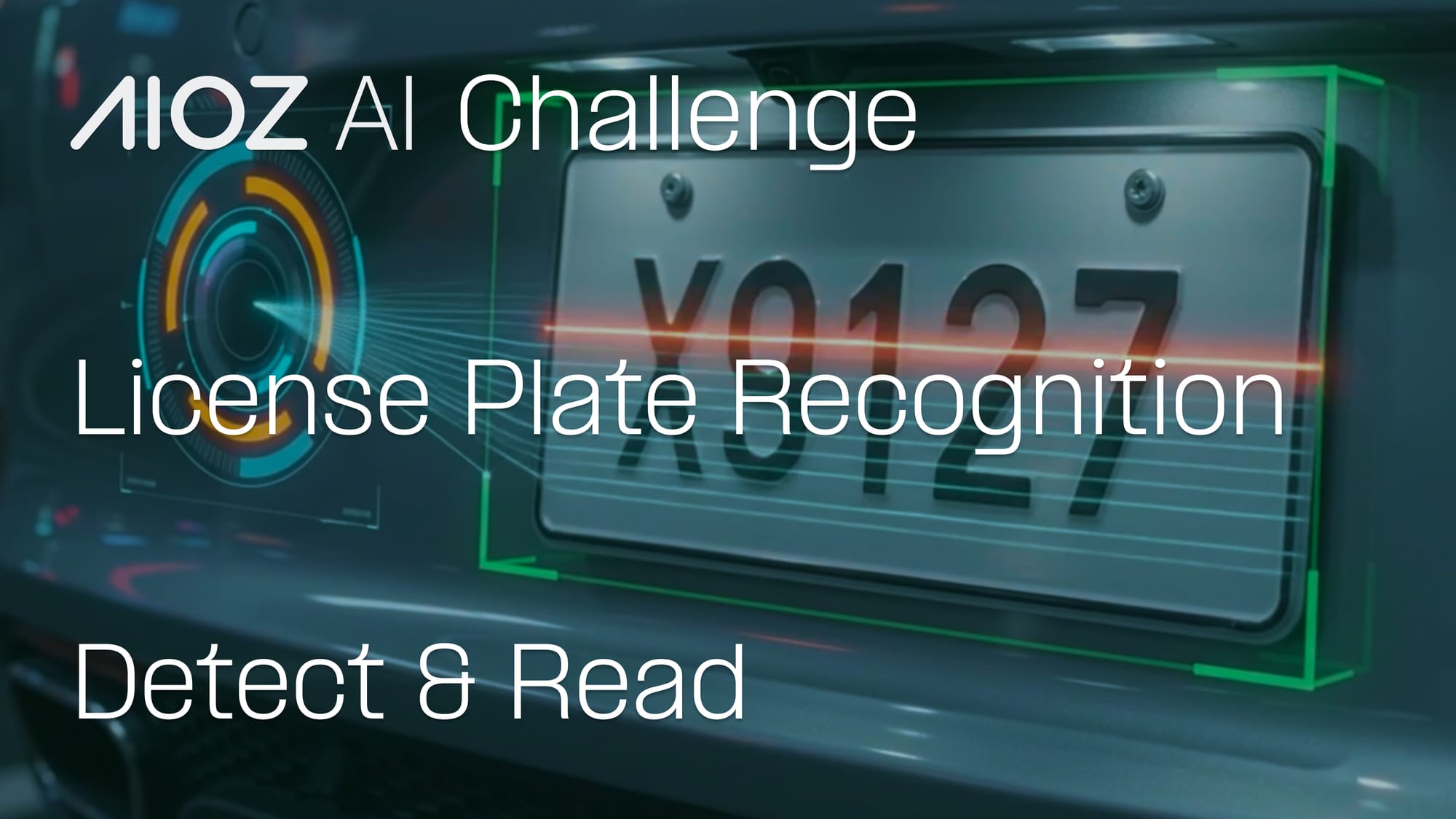
The License Plate Recognition Challenge on AIOZ AI helps you build a computer vision pipeline that locates license plates and reads their characters. You work with 1,444 vehicle images, including 866 training images and 578 public test images, across real-world camera conditions. Submissions are evaluated on both plate localization and character recognition, with 4,500 AIOZ tokens available in challenge rewards.
Why This Challenge Matters
License plate recognition is a practical computer vision task where a model has to do more than classify a clean image.
A strong system needs to find a small target inside a vehicle photo, crop or isolate that region, then convert the visual information into structured text. That detect-and-read pattern appears across toll systems, smart parking, fleet tracking, traffic monitoring, and other camera-based workflows.
What You Build
Participants build an end-to-end pipeline that performs two connected tasks:
- Object detection: Locate the license plate in each vehicle image.
- OCR: Read the characters printed on the detected plate.
Both stages matter. A detector that finds the plate but crops it poorly can make recognition harder. An OCR model that performs well on clean plate images may still struggle if the detected region is blurry, angled, or noisy.
Dataset Scope and Evaluation
The dataset includes vehicle images captured across varied real-world conditions. Images may come from traffic cameras, dashcams, or phones, with differences in lighting, weather, angle, distance, and plate appearance.
Dataset snapshot:
- 1,444 total vehicle images
- 866 training images
- 578 public test images
Submissions are evaluated across two dimensions:
- Detection quality: How well the system localizes license plates.
- OCR quality: How accurately the system reads plate characters.
The final score is split evenly between localization and recognition. Detection is measured with mean Average Precision, while text recognition is measured with Character Error Rate. Improving only one side is not enough; the challenge rewards balanced pipeline performance.
Challenge Timeline
Workflow You Can Practice
This challenge is useful because it trains a full computer vision workflow, not just a single model component.
Builders can practice:
- Detecting license plates in varied vehicle images
- Preparing cropped plate regions for OCR
- Testing robustness across lighting, weather, angle, and camera source
- Balancing mAP improvements with CER reduction
- Debugging errors between detection and recognition stages
- Improving a two-stage pipeline through controlled iteration
How to Start Efficiently
Start with a baseline detector and a readable OCR path, then inspect where the combined score loses points.
- Review the challenge task and scoring logic.
- Inspect examples across camera sources and conditions.
- Build a baseline plate detection workflow.
- Add OCR and validate the detect-then-read path.
- Submit early, then improve one stage at a time.
Start Building
The License Plate Recognition Challenge is a practical way to develop real-world computer vision skills across object detection and OCR.
Join the challenge on AIOZ AI, build your first detect-and-read pipeline, and start improving from your first submission.
FAQ
Q1: What does this challenge ask participants to build?
Participants build a system that detects license plates in vehicle images and reads the characters on each plate.
Q2: What computer vision skills does this challenge practice?
It focuses on object detection, OCR, data inspection, robustness testing, and two-stage pipeline debugging.
Q3: How large is the dataset?
The dataset includes 1,444 vehicle images, with 866 training images and 578 public test images.