DWPose: Whole-Body Pose Estimation from a Single Image
TL;DR
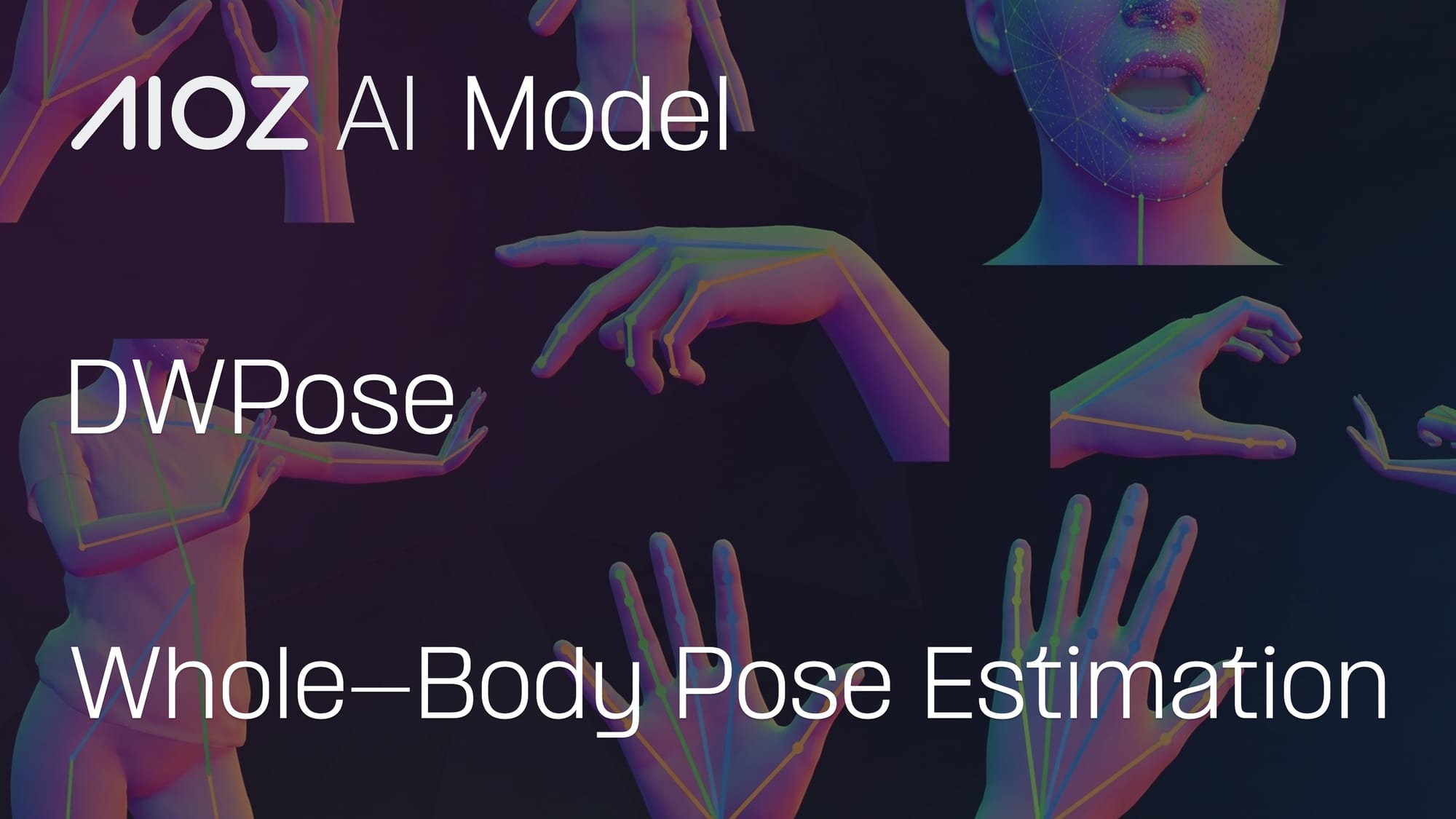
DWPose is a whole-body pose estimation model that extracts 133 keypoints across the body, face, hands, and feet from a single image.
Built on the RTMPose framework with a YOLOX person detector and a two-stage pose-distillation strategy, DWPose is designed to balance pose accuracy and inference speed across GPU and CPU environments.
What the Model Is
DWPose, now listed on AIOZ AI, is a whole-body pose estimation model for detecting and rendering detailed human poses.
Its full paper title is Effective Whole-body Pose Estimation with Two-stages Distillation. DWPose captures keypoints for the face, hands, and feet.
The resulting pose representation can support guided image generation, motion-capture preparation, virtual try-on, and broader human-pose analysis.

How DWPose Processes an Image
The workflow includes three main stages:
- Person detection: YOLOX identifies people in the input image
- Whole-body estimation: The RTMPose-based model estimates 133 keypoints across the body, face, hands, and feet
- Skeleton rendering: The detected poses are drawn onto a canvas and returned as an annotated image
Input and Output
- input: A local
.png,.jpg, or.jpegimage containing one or more human poses - output: An annotated
.pngimage with whole-body pose skeletons rendered on a canvas
The output is a pose canvas rather than raw motion-capture data or a newly generated image.
Technical Design and Runtime
DWPose builds on RTMPose and uses YOLOX for person detection.
It uses optimized ONNX model weights and is based on and inspired by IDEA-Research/DWPose, with ONNX weights sourced from fashn-ai/DWPose.
Developer requirements include:
- Python 3.10 or newer
- Git Large File Storage for model checkpoints
- Optional CUDA-capable GPU
A CUDA-capable GPU can accelerate inference but is not required.
Key Technical Details
- Model: DWPose
- Full name: Effective Whole-body Pose Estimation with Two-stages Distillation
- Task: Whole-body pose estimation
- Keypoints: 133
- Keypoint regions: Body, face, hands, feet
- Pose framework: RTMPose
- Person detector: YOLOX
- Training approach: Two-stage pose distillation
- Model format: ONNX weights
- Input formats:
.png,.jpg,.jpeg - Output format: Annotated
.pngpose canvas - Developer requirement: Python 3.10 or newer
- Checkpoint requirement: Git Large File Storage
- Optional hardware: CUDA-capable GPU
- Authors: Zhendong Yang, Ailing Zeng, Chun Yuan, Yu Li
- License: Apache 2.0
Where It Fits Best
- ControlNet OpenPose-guided image generation
- Motion-capture preparation
- Whole-body pose analysis
- Virtual try-on workflows
- Pose-conditioned creative tools
- Body, face, hand, and foot keypoint visualization
The pose canvas can serve as an input or reference for downstream applications.
Explore It on AIOZ AI
DWPose combines person detection, whole-body keypoint estimation, and pose rendering in one focused computer-vision workflow.
Explore DWPose on AIOZ AI and evaluate how its whole-body pose output fits your pose-guided applications.
FAQ
Q1: How many keypoints does DWPose detect?
It extracts 133 keypoints covering the body, face, hands, and feet.
Q2: What does DWPose return?
It returns an annotated .png image with whole-body pose skeletons rendered on a canvas.
Q3: What components does DWPose use?
It builds on the RTMPose framework, uses YOLOX for person detection, and applies a two-stage pose-distillation strategy.