Architectural Instance Segmentation for Building Elements
TL;DR
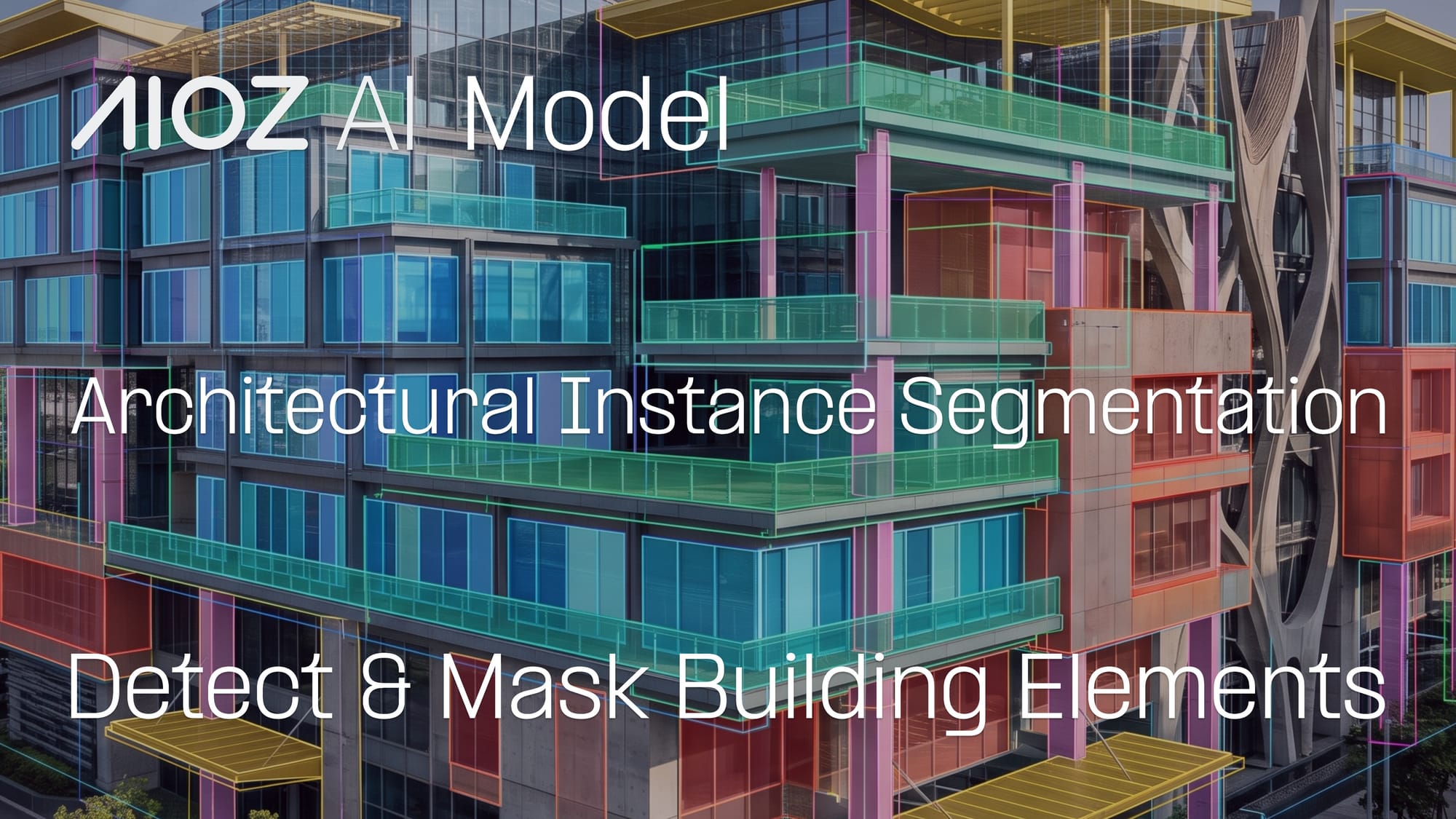
Architectural Instance Segmentation is a computer vision model for detecting and masking structural elements in building images. Built on YOLOv8n-seg, it identifies individual architectural elements and produces separate segmentation masks for each detected instance.
The current checkpoint recognizes five classes: window, door, column, wall, and beam.
What the Model Is
Architectural Instance Segmentation, now listed on AIOZ AI, is a fine-tuned instance segmentation model for building and facade imagery.
Unlike semantic segmentation, which labels broader image regions, instance segmentation keeps detected objects separate. Each recognized element receives its own mask, class label, confidence score, and bounding box.

How the Model Processes an Image
The model combines detection and segmentation in one workflow:
- Load image: Prepare the input
- Detect elements: Identify supported building elements
- Generate masks: Create one mask per instance
- Filter results: Apply confidence and IoU thresholds
- Render output: Produce the annotated image
The checkpoint was trained with a 640-pixel image size.
Input and Output
The model accepts:
input_image: Required local path or HTTP(S) URL for a JPEG, PNG, WebP, or BMP imageconfidence_threshold: Optional minimum confidence from0to1, default 0.25iou_threshold: Optional non-maximum-suppression IoU threshold from0to1, default 0.70device: Optionalcpu,cuda, orgpu; defaults to CUDA with CPU fallback
It returns:
output_image: An annotated PNG namedarchitectural_segmentation.png
Technical Design and Runtime
The model uses YOLOv8n-seg through Ultralytics 8.3.233 and PyTorch.
The checkpoint is stored at: models/instance_segmentation/best.pt
Developer requirements include:
- Python 3.10 or newer
- Git LFS for the model checkpoint
- Optional CUDA-capable GPU
A compatible GPU can accelerate inference, while CPU execution is also supported.
Key Technical Details
- Task: Instance segmentation
- Architecture: YOLOv8n-seg
- Framework: Ultralytics 8.3.233 with PyTorch
- Training image size: 640 pixels
- Classes:
window,door,column,wall,beam - Supported image types: JPEG, PNG, WebP, BMP
- Image sources: Local path or HTTP(S) URL
- Controls: Confidence and IoU thresholds
- Runtime devices: CPU, CUDA, or GPU selection with CPU fallback
Limitations
- Performance may vary across architectural styles, viewpoints, lighting, and image quality
- Small, occluded, or ambiguous elements may be missed or merged
- Confidence and IoU thresholds may require workflow-specific tuning
- No evaluation data or benchmark metrics are provided
References and Licensing
The original repository is TanTan2025/archivision-yolo, uploaded by Zilong Tan under the name TanTan2025. The original model card attributes the model to the ArchiVision Team (2025).
The repository is declared MIT licensed, while the current best.pt checkpoint also embeds an Ultralytics AGPL-3.0 license notice.
Explore It on AIOZ AI
Explore Architectural Instance Segmentation on AIOZ AI and evaluate how its five-class segmentation fits your architectural vision workflow.
FAQ
Q1: Which architectural elements can the model recognize?
The checkpoint supports five classes: window, door, column, wall, and beam.
Q2: Can detection sensitivity be adjusted?
Yes. Builders can configure the confidence and IoU thresholds to adjust how predictions are filtered.
Q3: Can the model run without a GPU?
Yes. CPU execution is supported, while CUDA can be used for acceleration when available.